
What Is Sparse Merkle Tree (SMT)? How RLN Uses SMT for Rate Limiting
A Sparse Merkle Tree (SMT) is a fixed-size cryptographic tree where most leaves are empty by default. It proves membership or non-membership of any value


Where the Status community shares long form articles, thoughts, and ideas.
A Sparse Merkle Tree (SMT) is a fixed-size cryptographic tree where most leaves are empty by default. It proves membership or non-membership of any value

Ethereum gas fees spike when user demand for block space exceeds supply. EIP-1559, activated in August 2021, replaced blind auctions with a dynamic base fee

DeFi (decentralized finance) is a system of financial apps built on blockchains instead of banks. Users lend, borrow, trade, and earn yield through smart contracts.

Status Network is the first reputation-based L2 designed for humans and bots, enabling gasless transactions and composable privacy at scale. Today, we are introducing Bermuda,
Bringing you the more control over your digital footprint, view on-chain friends, Linea chain support, Keycard & dApps on mobile, smart QR code scan, and
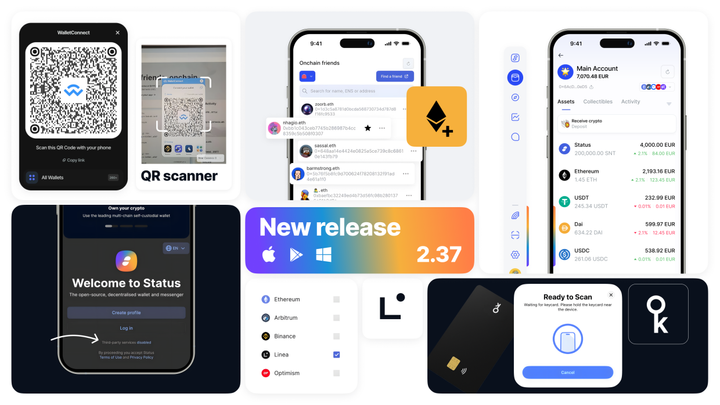
Release Roundup Status v2.37 brings you: * More control over your digital footprint. A Fully Sandboxed, Local-only Mode * Linea blockchain is now available in Status
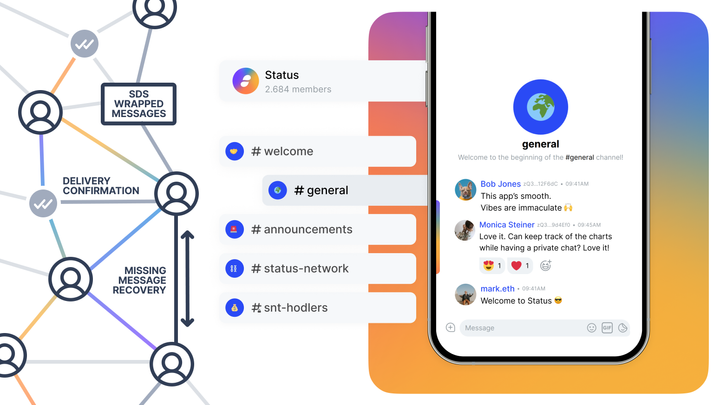
What is the SDS Protocol? SDS stands for Scalable Data Sync - a protocol designed to reliably synchronize messages across distributed, decentralized networks. Its full

GUSD is a yield-bearing meta-stablecoin built for Status Network. Deposit USDC, USDT, or USDS and receive GUSD, a single token that automatically allocates your capital

Most Layer 2 networks today still use gas fees. Even when those fees are low, users must hold native tokens, manage balances, and deal with

The Ethereum Dencun upgrade, activated on March 13, 2024, introduced EIP-4844 (proto-danksharding). This created a new data type called "blobs" that Layer 2

For years, the promise of blockchain technology has been hindered by a fundamental economic floor: the transaction fee. On gas-based networks, any interaction whose value

Ethereum gas is a unit that measures the computational work needed to process a transaction. Every action on Ethereum costs gas, paid in ETH. Fees

Data Availability (DA) is the cryptographic guarantee that all transaction data within a blockchain block is fully accessible for download and verification. Without DA, Layer

A zero-knowledge proof (ZKP) lets one party prove a statement is true without revealing any data beyond the truth of that statement. In blockchain, ZKPs

A liquidity pool is a smart contract holding paired tokens that traders swap against instead of matching orders with a counterparty. An automated market maker